McDonald’s Customer Satisfaction Programs
Understanding McDonald’s Customer Satisfaction Programs is essential for U.S. customers who want clarity on how their feedback is collected, evaluated, and used to improve service standards. Large restaurant chains rely on structured satisfaction systems to maintain consistency across thousands of locations, and McDonald’s is no exception.
These programs are not limited to online surveys. They include receipt-based feedback, customer experience policies, internal service benchmarks, and escalation procedures for complaints. When customers understand how the system works, they can share more useful feedback and know what outcomes are realistic.
This guide explains the why behind each component, not just the how. It is written for informational purposes only and does not imply any partnership or endorsement.
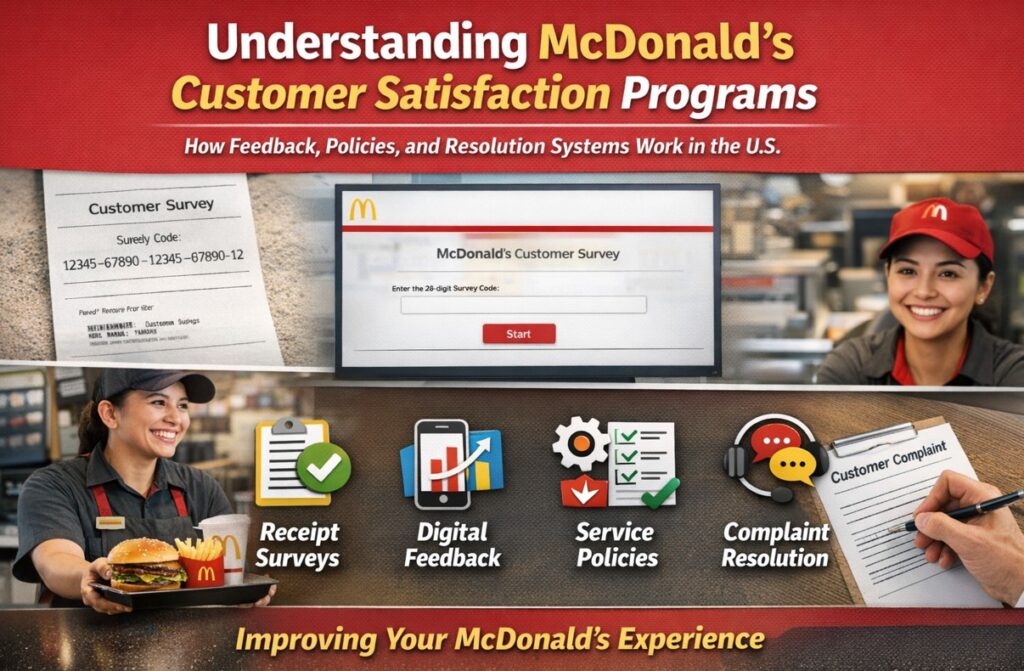
What Are Customer Satisfaction Programs?
Customer satisfaction programs are formalized systems designed to measure service quality and customer perception at scale. In the U.S. food service industry, these programs commonly include:
- Digital or receipt-based surveys
- In-store service standards and policies
- Complaint intake and resolution workflows
- Performance tracking at the store level
For a global brand like McDonald’s, customer satisfaction data helps ensure that a meal in one state meets comparable standards in another.
Why McDonald’s Invests in Customer Satisfaction Systems
The primary goal is consistency. With thousands of independently operated locations, McDonald’s uses standardized feedback programs to:
- Identify recurring service issues
- Track store-level performance trends
- Monitor policy compliance
- Support training and operational updates
Rather than focusing on individual rewards, the emphasis is on aggregated insights that guide decisions at regional and national levels.
Core Components of McDonald’s Customer Satisfaction Programs
1. Receipt-Based Feedback Surveys
Most customers recognize this component through surveys printed on receipts after a purchase. These surveys allow customers to comment on:
- Order accuracy
- Food quality and freshness
- Speed of service
- Cleanliness
- Overall satisfaction
Receipt-based systems ensure feedback is tied to real visits, which protects data accuracy.
For survey-related explanations and guides, you can also reference internal resources published on
2. Digital Experience Tracking
Beyond surveys, McDonald’s tracks customer experience across:
- Self-order kiosks
- Mobile app transactions
- Drive-thru service timing
- Digital order accuracy
These metrics complement survey feedback and help pinpoint operational issues that may not always appear in written comments.
3. Store-Level Service Policies
U.S. locations follow defined service policies that cover:
- Greeting standards
- Order confirmation procedures
- Food safety and cleanliness rules
- Issue escalation protocols
When survey feedback highlights repeated problems, these policies are often reviewed or reinforced internally.
How Feedback Data Is Evaluated
Individual vs. Aggregated Feedback
One crucial distinction customers should understand is how feedback is used:
- Individual responses are recorded and categorized
- Trends matter more than single entries
A single complaint may not trigger action, but repeated feedback pointing to the same issue often leads to internal review.
Sentiment and Category Analysis
Feedback is commonly grouped into categories such as:
- Speed
- Accuracy
- Courtesy
- Cleanliness
This allows management teams to focus on specific operational gaps rather than isolated comments.
Customer Complaint Resolution Steps Explained
McDonald’s customer satisfaction programs include defined complaint resolution pathways. These steps explain how issues are typically handled in the U.S.
Step 1: Feedback Submission
Customers may submit concerns through:
- Receipt surveys
- Online contact forms
- Customer service channels
Clarity and detail improve the usefulness of the feedback.
Step 2: Internal Review
Submitted feedback is:
- Logged in to internal systems
- Reviewed at store or regional levels
- Matched with operational data where applicable
Not all feedback results in direct replies, but all entries are stored for analysis.
Step 3: Escalation (When Applicable)
Issues related to:
- Food safety
- Repeated service failures
- Policy violations
May be escalated for closer review. Escalation does not guarantee personal follow-up but helps prioritize serious concerns.
Why Surveys Have Participation Rules
Customer satisfaction surveys follow strict rules to protect fairness and data integrity.
Common rules include:
- One response per receipt
- Time limits for participation
- Age eligibility requirements
- Non-employee participation only
These rules prevent duplicate entries and biased data.
Understanding What Surveys Do Not Do
It is equally important to understand limitations. Customer satisfaction programs generally do not:
- Guarantee compensation
- Replace customer support systems
- Provide immediate resolutions
They are analytical tools, not service desks.
For direct customer support policies, refer to:
Best Practices for Submitting Effective Feedback
Customers who want their feedback to be helpful should:
- Be specific and factual
- Avoid emotional or abusive language
- Focus on processes, not individuals
- Include time and context
Clear feedback improves the chances that trends are accurately identified.
How Satisfaction Programs Influence Improvements
Customer satisfaction data can influence:
- Staff retraining initiatives
- Equipment upgrades
- Changes in service flow
- Policy clarifications
While customers may not see immediate results, long-term improvements are often driven by accumulated feedback.
The Role of Transparency and Compliance
McDonald’s satisfaction systems operate under U.S. consumer protection expectations, including:
- Data privacy standards
- Fair participation rules
- Clear survey terms
Transparency builds trust in the feedback process and protects both customers and operators.
Final Thoughts
Understanding McDonald’s customer satisfaction programs helps U.S. customers know how feedback fits into larger service improvement systems. These programs are structured, data-driven, and focused on long-term quality rather than immediate outcomes. When used correctly, customer feedback supports consistency, policy enforcement, and operational refinement across thousands of locations.
For general survey-related explanations and educational content, internal informational resources may be found at:
For official policies and customer support access, refer to:
Disclaimer
All trademarks, brand names, and logos belong to their respective owners. This article is for informational purposes only and is not affiliated with, endorsed by, or sponsored by McDonald’s or any related brand.
Frequently Asked Questions (FAQs)
Are McDonald’s customer satisfaction programs mandatory?
No. Participation is voluntary and optional for customers.
Is feedback anonymous?
Most surveys do not require personal identifiers, though optional fields may exist.
How quickly is feedback reviewed?
Timing varies. Feedback is typically reviewed in batches rather than instantly.
Does every complaint receive a reply?
No. Many responses are analyzed without individual follow-up.
Can feedback affect a specific store?
Yes. Repeated feedback trends can prompt store-level reviews.
Are survey rules the same across all U.S. locations?
Core rules are similar, but minor variations may exist.
Can employees participate in surveys?
No. Employee participation is generally restricted to avoid bias.
What happens if a receipt is lost?
Without receipt details, some feedback channels may be unavailable.
Is survey participation linked to purchases?
Yes. Most survey systems require proof of purchase.
Do satisfaction programs guarantee rewards?
No. Programs focus on feedback collection, not guaranteed outcomes.
Can feedback be submitted online without a receipt?
Some contact forms allow general feedback, but survey systems usually require a receipt.
Why does McDonald’s rely on surveys instead of direct complaints?
Surveys provide standardized, comparable data across locations.